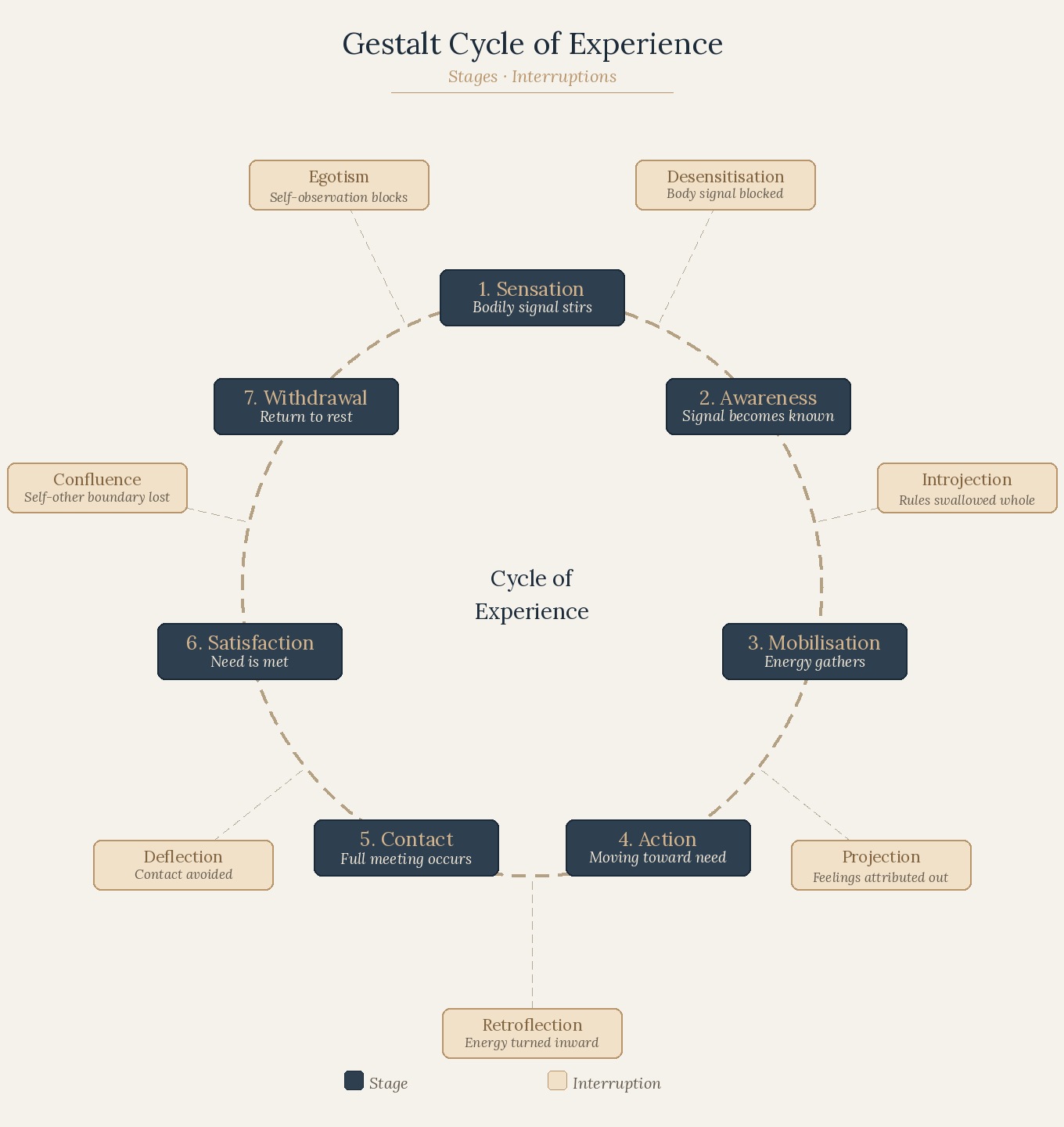
How one moves from stages of awareness and contact in meeting needs

Sometimes called the Cycle of Awareness or the Contact Cycle. This one of the foundational models in Gestalt therapy. Developed from the work of Fritz Perls and later elaborated by others including Joseph Zinker, it describes how a healthy organism moves from a state of rest, through awareness and action, into contact with the environment, and back to rest again. It is essentially a map of how we meet our needs.
Sensation
The cycle begins in the body. Something stirs — a physical sensation, a feeling, an impulse. Hunger, tension, longing, discomfort. At this stage the person may not yet know what the sensation means, it is simply a signal that something is happening.
Awareness
The sensation becomes conscious. The person begins to recognise what the body is communicating "I am hungry," "I am lonely," "I am angry." Awareness is the moment of knowing. In Gestalt, awareness itself is considered therapeutic, you cannot respond to something you haven't noticed.
Mobilisation of Energy
With awareness comes energy, the body and mind begin to orient toward meeting the need. Excitement, motivation, anticipation. This is the gathering of resources in preparation for action.
Action
The person moves toward what they need. They reach out, speak, create, move, engage. Something is done in the direction of meeting the need.
Contact
This is the heart of the cycle, the full meeting of self with other, or self with environment. True contact is not just proximity but genuine encounter. It is the moment of nourishment, the food is eaten, the connection is felt, the creative act is completed, the emotion is expressed and received. In Gestalt, contact is where growth and change happen.
Satisfaction / Withdrawal
The need is met. There is a sense of completion, fullness, satisfaction, resolution. The person can now withdraw from the figure (the thing that was needed) and return to ground, a state of rest and openness, ready for the next cycle to begin.
When the cycle is interrupted, when something prevents the person from moving smoothly from one stage to the next, a need goes unmet. These interruptions are not random; they are learned patterns, often developed in childhood as adaptations to environments that were not safe enough for full, authentic contact. They become problems when they are applied rigidly and outside of awareness.
Desensitisation (interruption at Sensation)
The person does not allow themselves to feel the initial sensation. They are cut off from their own bodily signals, numbed, disconnected, dissociated. They may not know they are hungry, tired, angry or sad because the signal never reaches consciousness. This is common in trauma, where feeling the body has come to feel dangerous.
Example: A person who has learned that expressing need leads to rejection may stop registering the need itself.
Introjection (interruption at Awareness)
The person swallows whole the beliefs, values and rules of others without digesting or questioning them. "I should," "I must," "good people don't feel angry," "needing help is weakness." These introjects, messages absorbed from caregivers, culture and society sit inside the person and interrupt authentic awareness of what they actually feel, need or want.
Example: A child told "you have nothing to cry about" learns that their sadness is wrong, and so suppresses awareness of it.
Projection (interruption at Mobilisation)
The person attributes to others what actually belongs to themselves — feelings, impulses, qualities they cannot own. Rather than mobilising the energy of their own anger, desire or need, they experience it as coming from outside. "They are angry with me" rather than "I am angry." "Everyone judges me" rather than "I judge myself."
Example: Someone who cannot own their own critical voice experiences others as constantly criticising them.
Retroflection (interruption at Action)
The person turns back on themselves what they want to do to others, or what they want others to do for them. Instead of expressing anger outward, they direct it inward, self-criticism, self-harm, depression. Instead of reaching out for comfort, they comfort themselves. The energy that should move toward the environment is redirected back at the self.
Example: Instead of telling someone "I am hurt by what you did," the person withdraws and becomes self-critical.
Deflection (interruption at Contact)
Just as contact is about to happen, just as something real and meaningful is within reach, the person moves away from it. They change the subject, make a joke, intellectualise, minimise, look away. They avoid the full impact of the moment. Deflection protects against intimacy, vulnerability and the risk of being fully seen.
Example: Someone receives a genuine compliment and immediately dismisses it or deflects with humour.
Confluence (interruption at Contact or Withdrawal)
The person loses the boundary between self and other, they merge, blur, lose themselves in the relationship or the experience. There is no separate "I" and "you," only "we." The person cannot tolerate difference, disagreement or separateness. They may agree with everything, absorb the other's feelings as their own, or be unable to withdraw and return to themselves.
Example: Someone who cannot say no, cannot hold a different opinion, and experiences the other's mood as their own.
Egotism (interruption at Satisfaction/Withdrawal)
The person observes themselves in the contact rather than being fully in it, they become self-conscious, watching and evaluating their own performance rather than surrendering to the experience. They cannot let the nourishment fully land. This can also appear as an inability to fully withdraw, to rest, to complete, to let the cycle close.
Example: Someone receives a moment of genuine connection but immediately analyses it rather than simply feeling it.
What makes this model so useful therapeutically is that these interruptions are not pathologies, they were once creative adjustments. The child who learned to retroflect their anger was doing something intelligent in a situation where expressing anger was dangerous. The person who deflects from intimacy learned that closeness was unsafe. The work of Gestalt therapy is not to pathologise these patterns but to bring them into awareness, to help the person see where and how they interrupt their own cycle, and to experiment, in the safety of the therapeutic relationship, with what it might be like to let the cycle complete.
The interruptions show up in the room, in how a person speaks, where they look, how they breathe, what they avoid. The therapist's role is to notice, name and work with the contact boundary, supporting the client to move toward more flexible, aware and nourishing contact with themselves and their world.